
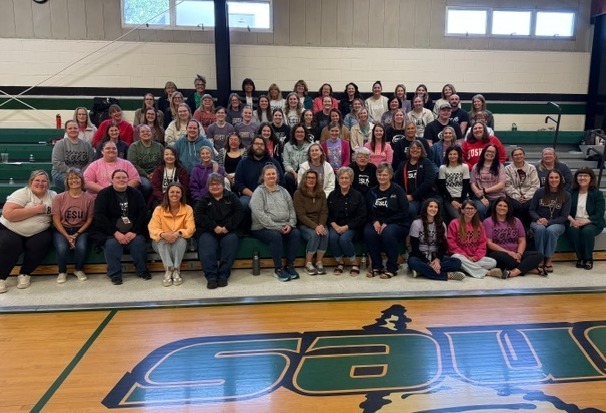
If you think education happens under just one roof or within a single building—think again. At the Educational Service Unit 8 (ESU 8), located in Neligh, the work of supporting students stretches far beyond the walls of a single building. With staff spread across 7 counties and 18 school districts, ESU 8 is a hub of collaboration, creativity, and commitment.
ESU 8 employs 108 dedicated staff members, all working together to support students and schools. A large and impactful portion of that team is in special education, where professionals with a wide variety of expertise come together with one shared goal: helping every student succeed.
Special education isn’t just one job—it’s a team effort made up of many different roles, each bringing unique skills and perspectives. These educators support students with diverse needs, ensuring access to learning, communication, independence, and growth. And the best part? These programs continue to grow, reaching more students and making a difference every single day. For example, in 2014-2015 , ESU 8 employed 71 educators in special education, whereas now, we employ 83 educators in special education.
So, what does a career in special education actually look like? Here’s a closer look at some of the roles that make it all happen:
Special Education Administrators
Lead programs, support staff, ensure compliance with laws, and help shape services for students.
Degree:
Master’s or higher in Special Education or Administration
Administrative Assistants
Keep everything running smoothly behind the scenes—scheduling meetings, managing paperwork, and supporting staff and families.
Degree:
High school diploma or associate’s degree (varies)
Special Education Teachers
Provide direct instruction, adapt curriculum, and support students with individualized learning needs.
Degree:
Bachelor’s degree in Special Education
Paraprofessionals
Work alongside teachers to support students in the classroom with academics, behavior, and daily skills.
Degree:
High school diploma; additional certification or coursework may be required
Teachers of the Deaf and Hard of Hearing
Support students with hearing loss through specialized instruction and communication strategies.
Degree:
Bachelor’s or Master’s in Deaf Education
Early Childhood Special Education Teachers
Work with young children (birth–age 5) to build foundational developmental and learning skills.
Degree:
Bachelor’s degree in Early Childhood Special Education
Teachers of the Visually Impaired
Help students with vision loss access learning through alternative methods such as Braille and assistive technology.
Degree:
Master’s Degree in Visual Impairment
School Psychologists
Assess student needs, complete evaluations for special education eligibility, support mental health, and help teams develop plans for student success.
Degree:
Ed Specialist degree in School Psychology
Speech-Language Pathologist Assistants (SLPAs)
Work under the supervision of an SLP to help deliver speech and language services.
Degree:
Bachelor’s degree in communication disorders
Speech Paraeducators
Assist in implementing speech and language activities with students who are receiving speech therapy from an SLP via teletherapy
Degree:
High school diploma; additional training often required
Speech-Language Pathologists (SLPs)
Diagnose and treat communication disorders, helping students find their voice—literally.
Degree:
Master’s degree in Speech-Language Pathology
From classrooms to communities, these professionals bring passion, patience, and expertise to their work every day. Special education is more than a service—it’s a commitment to ensuring all students have the opportunity to learn, grow, and thrive.
At ESU 8, that commitment is alive and well—and making a difference across northeast Nebraska, one student at a time